Description
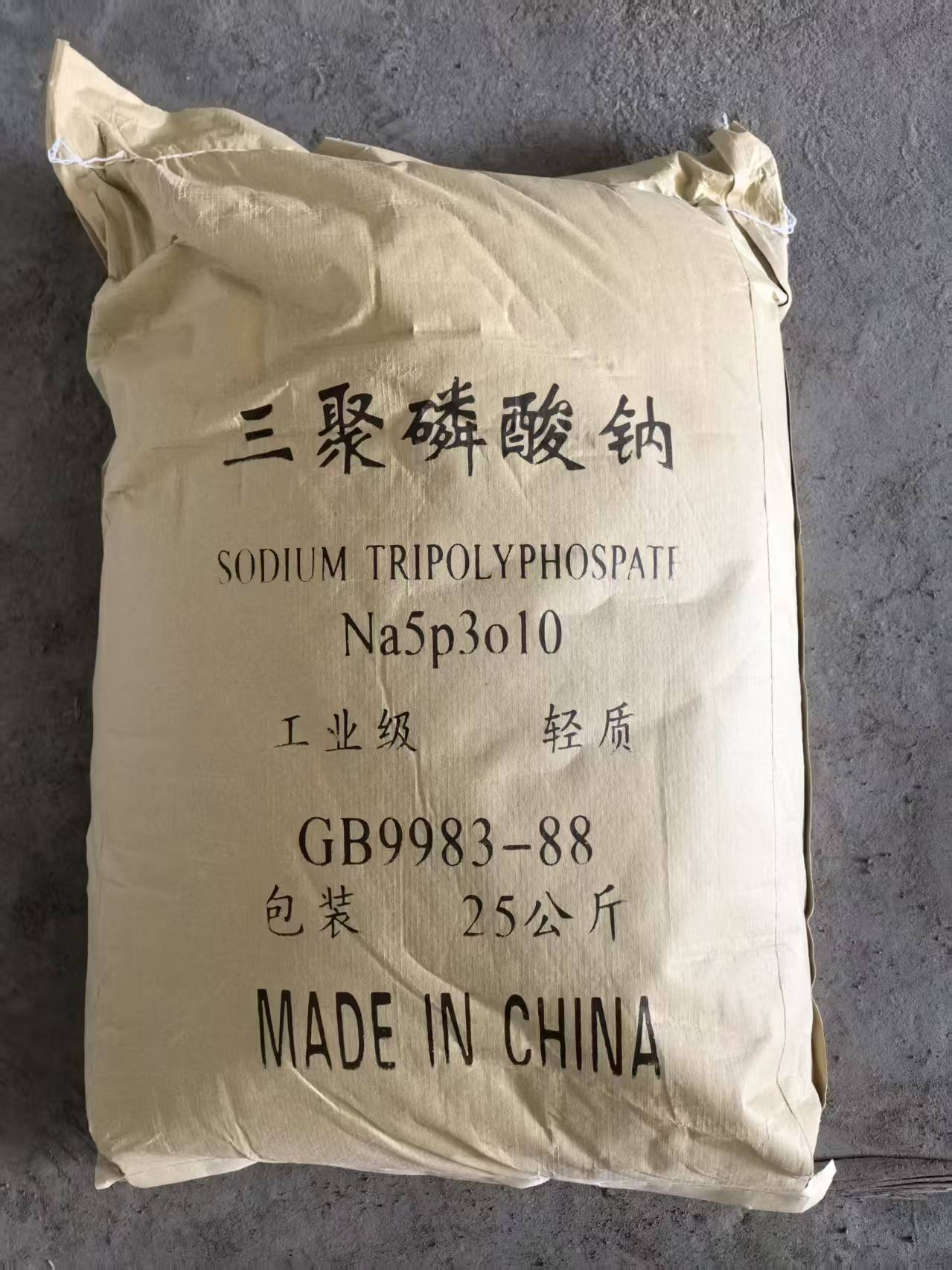
| Chemical name: | Sodium tripolyphosphate |
| English Name: | Sodium Tripolyphosphate |
| Molecular formula: | Na5P3O10 |
| Molecular weight: | 367.86 |
| CAS NO: | 7758-29-4 |
| Sex: | White powder, melting point 622 °C, easily soluble in water, has significant chelation ability for metal ions such as calcium and magnesium, can soften hard water, turn suspension into solution, has weak alkaline, non-corrosive, is an inorganic surfactant, has a strong emulsifying effect on lubricating oil and fat, and the bulk density is usually divided into low density 0.35-0.5g/cm3 and medium density 0.51-0.65g/cm3 , high density 0.66-0.9g/cm3. |
| Usage: | It is used in synthetic detergent formulations, textile dyeing, and is also used as a dispersant, co-solvent, etc |
| Packaging: | Lined with polyethylene plastic bag, outer plastic woven bag, 25Kg per bag. |
| Quality indicators | National designation standards |
| The main content of sodium tripolyphosphate was ≥ w/% | 94.0 |
| Total phosphate (in terms of P2O5), w/% | 56.0~58.0 |
| Water insoluble, w/% ≤ | 0.1 |
| Heavy metals (in terms of Pb), mg/kg ≤ | 10 |
| Lead (Pb), mg/kg ≤ | 4 |
| Arsenic (As), mg/kg ≤ | 3 |
| Fluoride (in F), mg/kg ≤ | 50 |
THE USES OF SODIUM TRIPOLYPHOSPHATE (STPP)
Sodium tripolyphosphate: A chemical star with multiple applications
Sodium tripolyphosphate (STPP) is a white crystalline powder that is highly soluble in water and its aqueous solution is alkaline. With its unique chemical properties such as chelation, suspension, dispersion and buffering, it plays an indispensable role in many industries. Its application scope is extensive, ranging from daily consumer goods to industrial manufacturing and even food processing. The following will provide a detailed introduction to the main uses and application scope of sodium tripolyphosphate.
I. Food Processing Field: Expert in quality improvement and preservation
In the food industry, sodium tripolyphosphate, as an important food additive, is mainly used to adjust the pH level, enhance the taste, lock in moisture, and extend the shelf life of food. It can enhance the water retention of proteins, making meat products such as ham and steaks more tender and smooth, and improving the overall texture. At the same time, when applied to seafood and aquatic products, it can effectively increase weight, retain water and maintain a fresh taste. In addition, in fruit juice beverages, it acts as an antioxidant, helping to delay the oxidation process and extend the shelf life. Relevant standards in our country have stipulated its application scope and limits in food to ensure safe use.
Ii. Detergents and Cleaning Products: Core Additives
Sodium tripolyphosphate is one of the main components of synthetic detergents (such as laundry powder), accounting for a significant proportion. Its core functions include: chelating calcium and magnesium ions in hard water, preventing scale from depositing on clothes, and softening water quality; Disperse grease and dirt to enhance the cleaning effect; It provides stable foam and a weakly alkaline environment, which is conducive to removing acidic stains. Meanwhile, the pH balance of the detergent solution is maintained through buffering. These characteristics make it the key for detergents to remove dirt efficiently.
Iii. Industrial Applications: Multifunctional Treatment Agent
Sodium tripolyphosphate has a wide range of uses in the industrial field:
Water quality treatment : As a water softener, it is used in boilers and cooling water systems to prevent scaling and extend equipment service life.
Leather making and textile : Used as a pre-tanning agent in leather making to treat raw hides; It is used as a color-fixing agent in dyeing processes to enhance the color of fabrics.
Other industries : applied in the paint, ceramic and paper industries as a dispersant or de-gumming agent; In metal surface treatment, decontamination and rust prevention; It is used as a mud dispersant in oil extraction.
Iv. Medical and Special Purposes: Emerging Applications
Although mainly concentrated in the industrial and food sectors, sodium tripolyphosphate also has applications in the medical field, such as being used as an ionic crosslinking agent in the production of hemostatic materials. However, it is necessary to be aware of its potential risks. Excessive intake may affect health, so the safe dosage must be strictly followed.
Summary
Sodium tripolyphosphate, with its multifunctional chemical properties, has become a star ingredient in food processing, detergents and industrial manufacturing. From improving food quality to enhancing cleaning efficiency and optimizing industrial processes, its applications almost cover every aspect of modern life. With the advancement of technology, its applications are still expanding, but rational use and safety remain the core considerations.
Reviews
There are no reviews yet.