Description
| Chemical name: | Glyox acid |
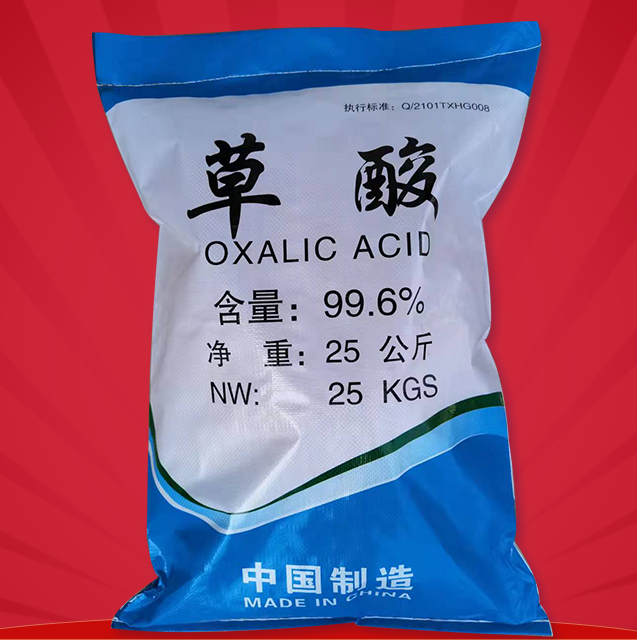
| English Name: | Oxalic acid |
| Molecular formula: | C2H2O4 |
| Molecular weight: | 90.03548 |
| CAS NO: | 144-62-7 |
| Sex: | Characteristics Colorless transparent crystals. Melting point 101-102°C Relative density 1.653 Solubility It is easily soluble in ethanol, soluble in water, slightly soluble in ether, and insoluble in benzene and chloroform.Common oxalic acid usually contains two molecules of crystalline water (H2C2O4· 2H2O, CAS number 6153-56-6). |
| Usage: | It is mainly used as a reducing agent and bleaching agent, a mordant in the printing and dyeing industry, and is also used to refine rare metals and synthesize various oxalates, oxalates and oxalamides. |
| Packaging: | Lined with polyethylene plastic bag, outer plastic woven bag, 25Kg per bag. |
| Quality indicators | GB/T1626-2008 |
| Oxalic acid content (%). | 99.6 |
| Sulfate (%). | 0.07 |
| Burn residue (%). | 0.01 |
| Heavy metals (in Pb) (%). | 0.0005 |
| Chloride (%). | 0.0005 |
| Iron content (%). | 0.0005 |
| Calcium content (%). | 0.0005 |
Reviews
There are no reviews yet.